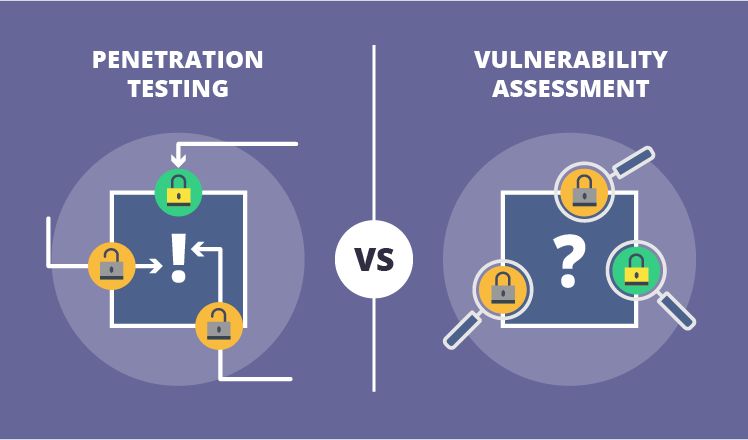
In today’s digital landscape, cybersecurity is a top priority for organizations of all sizes. As cyber threats continue to grow, businesses must take proactive steps to protect their systems, data, and users. Two common approaches used in cybersecurity are vulnerability assessment and penetration testing. Although they are often mentioned together, they serve different purposes and should not be confused.
This article explains the key differences between penetration testing and vulnerability assessment in a simple and easy-to-understand way.
What Is a Vulnerability Assessment?
A vulnerability assessment is a process of identifying, analyzing, and prioritizing security weaknesses in a system. It usually involves automated tools that scan networks, applications, and devices to detect known vulnerabilities.
The main goal of a vulnerability assessment is to answer the question:
“What are the possible security weaknesses in our system?”
Some common features of vulnerability assessments include:
-
Automated scanning tools
-
Identification of known vulnerabilities
-
Risk ranking based on severity
-
Regular and frequent execution
For example, a vulnerability scan might detect outdated software, missing patches, or misconfigured settings. It provides a broad overview of potential issues but does not go deeper into how those issues can be exploited.
What Is Penetration Testing?
Penetration testing, often called “pentesting,” is a more advanced and hands-on approach. It involves simulating real-world cyberattacks to see how vulnerabilities can actually be exploited.
The main goal of penetration testing is to answer:
“How can these vulnerabilities be used to compromise our system?”
Unlike vulnerability assessments, penetration testing is usually performed by security experts who think like attackers. They manually test systems, attempt to bypass defenses, and evaluate how far they can go once access is gained.
Key characteristics of penetration testing include:
-
Manual testing combined with tools
-
Simulation of real attack scenarios
-
Exploitation of vulnerabilities
-
Detailed reporting with practical impact
Key Differences Between the Two
Although both methods aim to improve security, they differ in several important ways.
1. Purpose
Vulnerability assessment focuses on identifying weaknesses, while penetration testing focuses on exploiting those weaknesses to understand real risk.
2. Depth of Analysis
Vulnerability assessments provide a broad overview, covering many systems quickly. Penetration testing goes deeper, analyzing fewer targets but in much greater detail.
3. Methodology
Vulnerability assessments rely heavily on automated tools. Penetration testing combines tools with human expertise and creativity.
4. Output
The result of a vulnerability assessment is usually a list of vulnerabilities with severity levels. Penetration testing provides a detailed report showing how an attacker could exploit weaknesses and what the impact would be.
5. Frequency
Vulnerability assessments are performed more frequently, often monthly or quarterly. Penetration testing is typically done less often, such as annually or after major system changes.
Why Both Are Important
Some organizations mistakenly believe they only need one of these approaches. In reality, vulnerability assessment and penetration testing complement each other.
Vulnerability assessments help organizations continuously monitor their systems and identify new weaknesses. Penetration testing, on the other hand, validates whether those weaknesses can be exploited and how serious they really are.
Using both methods together provides a more complete understanding of an organization’s security posture.
A Simple Analogy
To better understand the difference, think of a vulnerability assessment as a health check-up. It identifies potential health issues and risk factors.
Penetration testing, on the other hand, is like a stress test. It pushes the system to its limits to see how it performs under real pressure.
Both are important for maintaining overall health—in this case, the health of your IT systems.
When Should You Use Each?
Vulnerability assessments should be conducted regularly as part of routine security maintenance. They are ideal for identifying issues early and ensuring systems remain up to date.
Penetration testing should be performed:
-
Before launching new systems or applications
-
After major changes or upgrades
-
Periodically to evaluate overall security
Organizations handling sensitive data or operating in high-risk industries may need more frequent penetration testing.
Conclusion
Understanding the difference between vulnerability assessment and penetration testing is essential for building a strong cybersecurity strategy. While they may seem similar, they serve different roles.
Vulnerability assessment helps identify potential weaknesses, while penetration testing shows how those weaknesses can be exploited in real-world scenarios.
By combining both approaches, organizations can not only detect vulnerabilities but also understand their impact and prioritize fixes effectively. In a world where cyber threats are constantly evolving, this layered approach is key to staying secure.
Ultimately, cybersecurity is not about choosing one method over the other—it is about using the right tools together to create a comprehensive defense strategy.
As an experienced IT System Integrator, iLogo Malaysia is ready to help your company build a comprehensive cybersecurity strategy—from cybersecurity training and endpoint solutions to the implementation of integrated defense systems.